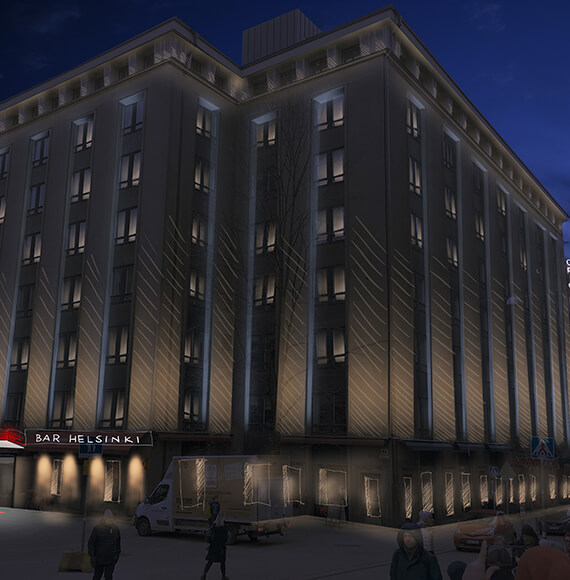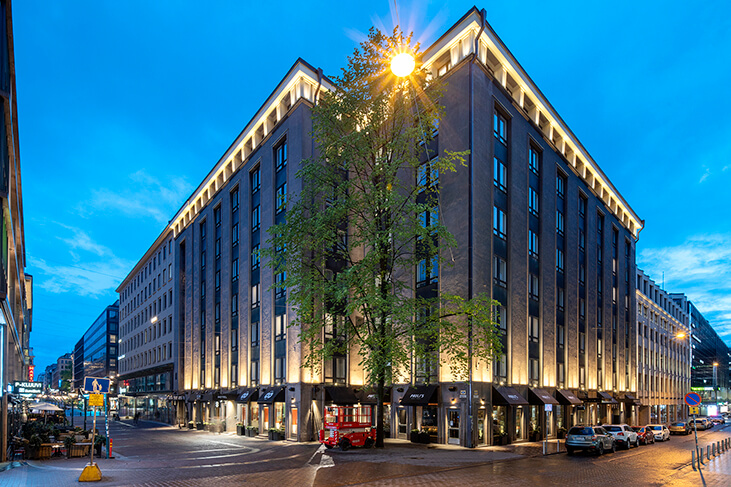
Solo Sokos Hotel Helsinki opened its doors after an interior renovation project and now stands out with its new facade lighting. The renewed lighting also serves as a means to communicate the interior renovations to the street level.
Information
Type Facade lighting
Location Helsinki
Completion Year 2022
Client Sokotel
Hotel Helsinki, located at the corner of Kluuvikatu and Yliopistonkatu, first opened in 1930 as part of the Finnish Savings Bank’s commercial building. Upon its completion, it was Finland’s first grand hotel. The building, which represents classicism, was originally designed by architect Pauli E. Blomstedt.
During the day, the hotel’s architecture is characterized by the beautiful detailing of the attic floor, the dark, warm-toned terrazzo facade, the recessed windows, and the street awnings. At night, the dark hotel almost disappeared into the surrounding ambient light. The cool-toned facade luminaires added over time were prominent fixtures, shaping the view and creating strong light and shadow patterns on the wall surfaces, while the ornamentation of the top floor remained in darkness.
The client was already familiar with Valoa through previous successful projects and reached out. The aim was to create new lighting that was more inviting and distinctive, yet relatively subtle and simple. Another objective was to brighten the street level, as it was perceived as dark in the evenings.
“A rather moderate and style-appropriate lighting solution was created for Hotel Helsinki. The lighting softly highlights the building’s terrazzo surface and naturally emphasizes its verticality and tall window lines. Light also brings out the decorative details of the top floor, which often go unnoticed even during the day,” commented lighting designer Antti Hiltunen.
Lighting solutions were visualized using hand sketches and images compiled from test lighting. Based on the client’s wishes, necessary negotiations and permit matters were discussed with the building control authorities, together with architect Eero Mustonen. The entire lighting scheme was modeled into an existing 3D model, which facilitated discussions about lighting solutions and options as a whole. The model was also utilized to generate a luminaire map.
The new lighting is warm-toned, and the luminaires are also discreet during nighttime. By highlighting the street-level entrances, the area in front of the hotel no longer feels dark. The main entrance canopy was renovated during the refurbishment, and the warm accent lighting on the surfaces adds an inviting feel to the entrance.
The hotel is located in a challenging spot for visibility, in a somewhat narrow corner where it can easily go completely unnoticed. Now, light is brought to the street level, the building’s details stand out, and the surroundings have gained more brightness. The hotel also invites visitors to admire the interior renovations.